Monday, 22 April 2019

Unsanctioned Public Events

Vancouver, BC, near where I live on Canada's west coast, has just finished holding the annual 4/20 event on Saturday in glorification of cannabis culture. One of the main reasons it was held in the past was to protest and argue for the legalization of marijuana. For those who may not know, in 2018 Canada became the first country in the world to legalize marijuana. This has led many to question why the 4/20 event still needs to be held at all.


This year's event drew an estimated 60,000 people to the site which was one of the city's parks. The interesting thing about this was that the event was not sanctioned by the city at all and the Parks Board who must maintain this particular park, seemed reluctant to allow it either but their problem was that they had no authority to stop it; only the city did. In other words, the entire event was unsanctioned. Yet it still needed policing, first aid, electrical power, toilets, ground cover, etc, etc., much of which was provided by the city. Last year in 2018, the Parks Board managed to recoup just under $65,000 of their costs but the city recovered none of the $ 170,796 they invoiced the organizers.

Now I do not have a problem with such an event IF it is properly licensed and controlled, regardless of what the cause is. What I DO have a problem with are the consequences of potential disaster. This could range from injuries of attendees or workers, weather cancellations, crimes like assaults and theft, serious damage to the park and a host of others. If one or more of these were to occur, who would be responsible for making things right? I sincerely doubt that any insurance company would be willing to pay the bills, although in fairness, the organizers of this year's event claim they did have event insurance, but when push comes to shove, I still cannot see them parting happily with millions of dollars if the event has not been approved. The city would not for sure, nor the Parks Board. In fact, the city is already in debt for this event for policing alone and will never see that cost recouped from the event's organizers. And what about the suppliers of staging, tenting, portable toilets, audio, lighting, etc. if the promoters do not make enough money to cover those bills? Those suppliers would undoubtedly never see any money. What is worse, if they had any damage to or theft of, equipment, they would probably never be able to recover the cost from their own insurance company because the event was unsanctioned. Even working such an event I would deem to be damaging to a supplier's reputation because it would tell me that this supplier does not care about  risk management and playing by the rules - not a good place to be in this highly competitive special event industry.

I would strongly recommend to all suppliers for such an event to take a good hard look at what you are getting yourself into and stay as far away as possible from any promoter who is unwilling to do things the right and lawful way.


Monday, 17 December 2018

Event Management - A Profession or Not?

Is event management a "profession" yet? I have been pondering this question since I personally entered the field in 1985. Coming up to 2019, I would have to honestly say NO, it is not. Here is why - and for simplicity, I'm going to use my own original profession, engineering, for comparison.
  1. The field is fragmented. Practitioners can be found in several different categories, each of which has their own advocacy organization and certification. Some of these include: International Live Events Association for special events (which could mean anything these days and I have written about this extensively in my books - CSEP certification); International Festivals and Events Association for festivals (CFEE certification); International Association of Exhibitions and Events for expositions and trade shows (CEM certification); Meeting Professionals International, Professional Convention Management Association, and Association of Meetings Professionals, all for meetings and conferences (CMP certification for all these). In engineering, a true profession, there is only one advocacy body per geographical jurisdiction (e.g. state or province) for all types of engineering, whether it be mechanical, civil, structural, materials, aeronautical, or any other. Certainly some amalgamation has taken place in event management but not nearly enough to consider the field united.
  2. Certification and advocacy are self-serving. The certification process began in most of these advocacy bodies as many as thirty-plus years ago. At that time - and even today - the advocacy was and is self-serving. It appears to be done for superficial reasons and almost entirely to financially support the individual organizations themselves rather than to make the "profession" more responsible to the public and the individual members' clients. In engineering, the professional association is more attuned to advocating for the general public and members' clients in its role as a "watchdog" with strong disciplinary powers.
  3. Basic education requirements for entering the field are set at too low a standard. In most cases, no basic formal education is required to be granted a certification. In engineering, in every case, at least a university undergraduate degree in engineering is required, or the equivalent in experience. In these cases, the experience requirement is much more stringent than for the field of event management. As well, harder and more all-encompassing exams must be passed to be considered for certification than are given in the event management field.
  4. There is no public respect for this field. Most of the general public still views event managers as "party planners" no matter what the size or complexity of the event. Until there is extensive public education and media coverage, this perception likely will not change.
  5. There is a breath-taking gap between the theoretical side of events (i.e. those who study events from the point of view of such other professions as psychology, anthropology, history, and sociology among others) and the practical side of events (i.e. event managers). Currently it is mostly university scholars in various disciplines who pursue research in events and then publish their findings unbeknownst to the vast majority of practitioners, the very ones who should be the recipients of this knowledge. Theory in any profession must inform practice. Indeed, engineering requires that registered professional engineers maintain currency in the latest theories and advances in their field of endeavour. 
  6. Professional conferences do not exist. This is going to raise the hackles of many readers. The conferences that are generally available in the event management field are also self-serving. For the most part, they are hosted by such organizations as the aforementioned biased advocacy bodies and/or industry magazines, both of whose main purpose is to make money for themselves. I have been watching the topics offered at such conferences over the years and find that they continue to re-invent themselves in different forms but the content seldom advances theoretical knowledge about events. That is again because the purpose is to make money and the attendees to a large extent do not have a basic theoretical grounding, as do professional engineers. Somehow this has to change if event management is ever to be considered a profession. The academics must be invited to practitioner conferences, and vice versa. Sure, attendees may hear about the latest and greatest smartphone app for registering event attendees or the "in" colour for chair covers for this year, but do they hear about the latest theories in crowd movement predictions? Are they made aware of how important ritual is in event design? Do they know the psychological impact of different types of music on listeners and event attendees? Definitely not. Which topics are more important to the well-being of the event-going public - the colours of chair covers or how audiences may be affected by crowds, rituals, or music?
  7. Questionable ethics abound. The industry remains rife with kickbacks, referral commissions, favouritism, and intellectual property theft. Without a respected regulatory body with disciplinary authority this will never go away.
  8. Risk management still leaves a lot to be desired, especially with public events. Every year major disasters continue to occur all over the world, in many cases resulting in death and serious injuries to event attendees and employees. This must be dealt with. It would never be allowed to happen to the same extent in the engineering profession. Of the few times when it has happened, deterrent penalties have been extremely severe. 
How, then, does the industry advance to being considered a true profession? Here are a few ideas to start with.
  1. The industry must "get over itself." It's not a high school clique or a contest for the best looking  and most outgoing person. Only the most professional companies should succeed. To this end, restrictions must be put on entry to the profession. The most basic of these should be a requirement for an undergraduate university degree, with programs that are multi-disciplinary.
  2. Advocacy organizations across the industry must amalgamate into a single entity responsible for certifying practitioners and organizing official industry conferences whose primary goal is to advance knowledge, especially theoretical knowledge.
  3. This single entity must further be given the authority - with the public's blessing and encouragement - to discipline breaches of industry ethics, particularly anything to do with safety.
  4. Consideration should be given by all industry sectors to re-naming the discipline as "event studies." Within this discipline must fall all education, including all existing courses and programs in "event management" given at universities, community colleges, and conferences, but adding courses from other disciplines as they relate to events, including anthropology, history, psychology, sociology, and even religious studies, economics and others.
  5. A cross-industry public education program must begin as soon as possible to explain what event managers do and why they are needed as the professional overseers of events.
Who should instigate these changes? Maybe that question is better worded as "Who has the courage to instigate these changes?" Anybody can do it, but if it is someone from within the industry, there may be consequences in terms of getting contracts or staying employed. At the very least, I think it should be a topic of conversation at all future conferences, which also may be hard, considering the sponsors of the conferences. Maybe the best person is someone like me who has nothing to lose and can view the industry from an unbiased, external point of view. I would welcome the opportunity to present my ideas at any industry gathering.

Wednesday, 3 May 2017

Photographing Onstage Event Action

I'm relatively new to photographing live action at special events, although I have actually been a photographer all my life. I am rapidly learning how difficult it is to get really good images of onstage action at events. I'll share a few ideas from my experience.

First, if you want to catch stage performances up close and personal, you are going to have to put yourself right at the stage itself, preferably directly in front. Depending on the event and your part in it, you may need to get special permission from the organizers to allow you to place yourself there. This often involves getting an "All-Access Pass," which allows you to wander most anywhere with the typical exception of right ON the actual stage.

Second, you are not going to be able - or allowed - to use flash, mainly for two reasons: one, it is distracting to performers; two, because of the way cameras read light, you will inevitably have a very dark background and too much light on the performers closest to you. If you are further back from the stage than "the pit" directly in front, you will likely get only a shot of the first few rows of peoples' heads in front of you with a dark stage. People who try to take shots of concerts from up in the stands will usually end up with just this - well-lit heads and no stage action.

As for equipment, there is lots of information available on the web for shooting concert action. Let me briefly summarize:

  • Use a camera that can shoot at high ISO (i.e. up to at least 3200 or 6400) and crank the ISO up to around there, usually at least above 2000. Oh, yes, and put your camera in Manual mode.
  • Use a "fast" lens with as large an aperture as your budget will allow. 1.7 is great if you can get one. Whatever lens you use, you will need to open it to its widest aperture to let in as much light as possible. 
  • With a wide open lens and high ISO, you can play with shutter speed to do several things. The first is stop the action, so if you have dancers, for example, you will need a shutter speed of at least 1/100 sec, preferably faster. However, if you want to catch more of the exciting lighting shooting beams through haze, you will need a slower speed, probably under 1/100 sec. As you might guess, each of these presents a dilemma - either you get clear, in-focus performers with little fancy lighting effects, or you get nice lighting effects with possibly out-of-focus performers. You need to play around with speeds and ISO to hit it just right.
  • I prefer to use a super wide angle lens to capture the whole essence of the performance. My favourite is a 10-24mm Nikkor lens with which I can pretty well capture the entire stage, including lighting, from right at the downstage edge.
After you finish, you will undoubtedly need to do a fair bit of post-processing (i.e. work in either Lightroom or Photoshop). Why? Because most of the shots will no doubt have either a little bit or a lot of graininess due to the high ISO setting. Much of this can be taken out with software, Nik Define 2 being my personal favourite. You also may also have to play with colour temperature, exposure in some areas of the image, cropping, brightness, contrast and a few others. 

If you follow these general guidelines, you will likely get some good  - or even great - shots, but it does take work and practice. 

Below are a couple of my most recent attempts.


Friday, 9 December 2016

Don't Go Cheap on Audio

In my spare time I am also a pianist/organist and last night I, along with other musicians and a large choir, were rehearsing for an opening performance for a new church. The church has beautiful acoustics but is extremely reverberant. It is so much so that the sound designers for the building took out all of the low frequencies for the sound system that serves the altar.

As for those of us in the choir loft, we were on a separate mixer that feeds into the same main speaker system. Since the building is so reverberant this means that balancing the output is going to be a very critical matter. This is not the time to use cheap equipment (main speakers, microphones, mixer, monitors, etc) OR people who do not know how to mix properly. In a room that is so alive, it is very easy to go from low volume intelligible but barely audible speech, to a high volume ugly wish-mash of music. I know, because it has happened to me in many special events. Usually the reason is that the equipment (often the speakers) is incapable of handling the load or the audio tech is not knowledgeable enough to know how to fix equalization problems or how to set up main speakers, not to mention which types of mics to use in certain situations.

For example, in our rehearsal last night, we had to "make do" with a single vocal mic for a 30-voice choir. Of course, it sounded terrible. What should have been used was at least two or three choir mics (condenser overhead mics with unidirectional pickup) placed up high and just in front of the first row of singers. What happened? There was not enough of the right equipment (e.g. mics) available and we had minimal time to check and gain experience with the system.

So what is my point? It is that if you have an event that has a critical audio component (i.e. speeches, stage show, even a dance band), then you would be well served to not always go for the least expensive company to supply the audio. Do your homework and make sure you get techs who have lots of experience in running audio for your kind of event and that the company uses only the highest quality equipment. You will save money and your reputation in the end.

Thursday, 1 September 2016

Getting in the Creative "Zone"

In this industry creativity is a much-revered talent. Not only that, but it must be almost instantaneous creativity, thanks to short lead times for proposals.

I have practiced and taught creativity for many years, but only recently have I discovered what for me is the best scenario for coming up with good ideas. It is not a gimmick but it does involve getting up from your desk and doing a little exercise.

Basically it is walking at a steady but not too strenuous a pace and it must be done for at least 30 minutes and not up an incline. Personally if I do this on a nice level walking trail, particularly away from traffic, I find that after about 20 to 30 minutes, my mind starts to de-clutter. At this point once I feel relaxed and able to move smoothly, I begin to think about a problem or proposal or whatever needs solving. I find that very quickly I will begin to develop related ideas that are creative, logical, and ultimately workable. I then continue to concentrate on this generation of ideas and try not to think about the physical walking or about my surroundings. In reality, this seems to be a form of hypnotism if one can call it that. By the end, if it has been a productive walk and lots of ideas have come forth. I often think back and realize I have no idea how I got from the start to the finish of the walk as I was so involved with the great ideas.

This seems to beat many other techniques for generating ideas, at least for me. But why? Here is what I think. When we walk at a steady pace, it has been proven that most people tend to fall into a regular pace of 120 steps per minute. This coincidentally is the almost universal pace that armies march at because it literally makes their minds numb and susceptible to taking orders and it also fosters togetherness. Not only that, but recent studies have also analyzed top musical hits over the years and found that the majority of songs are at a tempo of - you guessed it - 120 beats per minute. Finally, this number corresponds to an actual frequency of 60 cycles per second, a "mesmerizing" frequency in our brains. 

Think about this as a way to come up with new ideas. If you try it, let me know if it works.

Friday, 11 March 2016

Lighting for Houses of Worship

I am not an expert in this type of event technology but my son, the lighting genius, certainly is. The images below, taken by me, show some of his recent handiwork on a local installation. Seems to me it would certainly enhance any service.


Wednesday, 23 December 2015

Determining Vertical Stage Size

My most popular post to date has been the one about determining horizontal stage size for an event. In this post, thanks to several questions, I address the vertical dimension.

The first assumption in determining the height of a stage is that the special event is not being held in a venue with a permanent stage such as a theater. Otherwise, the height is dependent on the size of the audience, whether they will be sitting or standing, and whether the ground or floor is level (we will assume in this section that the surface is level). Standing audiences can occur for concerts, receptions, dances, trade shows, product launches, and others. Seated audiences can occur at dining events, award ceremonies, opening and closing ceremonies, meetings, and numerous others. We will deal with each of these.

Standing Audience


In order to make an educated determination of the correct height for a standing audience, we must make some assumptions of human characteristic body dimensions and typical spacing between persons in a standing crowd. For purposes of this exercise only, let us assume that the average person is approximately 5 ft 11 in. (179 cm) tall and that in a standing crowd, people will tend to space themselves no closer than 2 ft (0.6 m) apart. Also, we must assume that persons in the crowd are able to maneuver themselves sufficiently to see over the heads of other persons two rows ahead of them (i.e. about 4 ft, or 1.2 m in front of them). If we further assume that at minimum any persons in the audience must see at least the top part of the head of an average person standing on the stage (near the front or downstage edge of the stage), then we can draw some sight lines to assist us with calculating the correct stage height that will relate directly to the size of the crowd. Figure 1 does just this. Note that at 25 ft (7.6 m) away from the stage, a person is able to see the top part of the head of someone onstage if the stage is 3 ft (1 m) in height. Likewise, at 50 ft (15 m) from the stage, the height must be raised to 4 ft (1.2 m) to achieve similar visibility and at 100 ft (30 m) away from the stage, the height must be at least 8 ft (2.4 m) for the same visibility. It is clear from this explanation that given a specific audience size and venue size, that a stage should be constructed of sufficient height to enable the entire audience to view the stage in the worst case scenario. For example, even in the case of a standup reception at which there will be stage entertainment, the assumption must be made that during the entertainment, attendees will crowd the stage to the extent that they will be about 2 ft apart, even though when the entertainment is not on, this may not be true.


Figure 1: Stage Height Determination for a Standing Audience

Seated Audience


For a seated audience, the height is also determined by the ability to see over the head of a person sitting directly across a table (if dining) or directly in front by two rows (if theater-style). We will illustrate the principle by using a dining situation in which diners are seated at 72 in. (1.8 m) diameter round tables, separated by 10 ft (3 m) center-to-center. Exactly the same principle applies as for the standing scenario, except that, because the distance from the observer to the person opposite is much greater than the critical distance in a standing crowd, the angle is lower and so the stage can be that much lower in height. Figure 2 illustrates the angles and can be used to calculate approximate stage heights. Once again, the worst case scenario must be assumed and if the tables are less than 72 inches in diameter (e.g. 60 in. or 1.5 m rounds) then the calculation must be rechecked. Note also that because of the low angle, a constant stage height may be used for the nearest 50 ft (15 m) to the stage before the stage height really needs to be increased, unlike the standing situation.


Figure 2: Stage Height Determination for a Seated Audience


It should be kept in mind that the variables in determining stage height are many (e.g. slope of ground if outdoors, proximity of audience members to each other, whether performers stay on mainly the downstage portion of the stage), so the above analyses are only intended to be general guidelines and not hard rules. Each situation will be different and in some cases, a lower stage might be adequate.

Read more about this and many other topics in my new books.

Sunday, 29 November 2015

More HDR Event Photography

Some of my latest HDR event photos. Now I am not an accomplished event photographer by any means and mostly I just do it as a learning experience because photography is my hobby. However, I cannot emphasize enough how important it is to have an amazing catalogue of images of your events if you are a planner or manager. This is what defines you and your company. Never settle for just acceptable - hire the very best event photographer you can to document your events and put only the best in your online portfolio.


Wednesday, 18 November 2015

Hot Ideas for Experiential Entertainment

Over the last week or so, I have been moderating a LinkedIn discussion about the perceived decrease in live entertainment at corporate events. Let me first condense the discussion into its main points and then offer some ideas for experiential entertainment.

First, many contributors agreed with me that there is less live entertainment nowadays, with most blaming it on cost and the apparent lack of return on investment. Some were of the opinion that corporate executives automatically cut entertainment when faced with a budget crunch. Typical examples given were using a DJ instead of a live band. Some talked about still using basic interactive entertainment such as magicians, caricaturists, and graphologists as value for money as far as their interactivity capability went.

In this discussion, my contention was, and still is, that planners desperately need to be educated and to up the creativity ante in order to obtain and successfully use live entertainment. This means taking the time to scour the web but also to occasionally step away from their computers and phones and venture out to things like festivals, nightclubs, and industry conferences where the latest and greatest in live entertainment is exhibited. To be a good planner, you need to thoroughly understand what a specific act can do. You cannot be lazy or trust the same old four or five acts or bands to be the right ones for every client. Sometimes it takes guts to challenge a client who says there is no budget when you know that there is an act that fits the existing budget and can wow the guests. More than anything, you have to ask the right questions about the purpose of the event and the message that the client wants to get across to guests. Armed with that information, you should be able to recommend several live entertainment options within the allowable budget. If you cannot, then you need to do more research if you want to rise above the competition. Having said that. what follows are some specific ideas that may help you start on the road to giving your clients an amazing experience using live, interactive entertainment (all suggestions have active links).


  1. Kung Fu demo team - I have personally used this before with success. I dressed up a kung fu group to look like guests. They started an argument in the buffet line and then got into a fight. Everyone was  totally surprised until they revealed themselves and gave a real martial arts demo.
  2. Tai Chi demo and participation - great for group participation and health
  3. Bedlam Slinkies - human slinky toys 
  4. Energetic Engineering - lasso and knife throwing 
  5. Crazy giant balloon show - performer inside a giant balloon
  6. The Belles - spandex-covered roving entertainers
  7. Wild costumed characters - these costumes are amazing
  8. Walkabout wearable projection - have fun with projections on guests
  9. The Living Garden - a beautiful garden comes alive
  10. Pickpockets - watch out!
  11. Beauty Boutique - an extreme glitter experience
  12. Firewall - combines sight, sound, and touch in a magical experience
These are only a tiny fraction of the unbelievably creative offerings out there if you search. In my experience, most performers, especially ones who do walkabout, roving, or table/reception entertainment, are usually more than happy to customize their performances to incorporate something unique about the event or the sponsoring organization. That, of course, makes it much more relevant.

More to come in another post about how to create stage shows with a truly experiential component.


Tuesday, 3 November 2015

Sponsor a Refugee Family NOW

This post is a departure from my regular ramblings about special events. This one is about the refugee crisis in the Middle East, an urgent, worldwide problem.

After headlines broke a couple of months ago finally recognizing the problem, people everywhere started clamouring to help with sponsoring refugees. Unfortunately, few knew where to go or what to do. The fact is, the majority of refugees, at least those coming to Canada, must be sponsored by community organizations or groups of five or more permanent residents. Applications to sponsor are also accepted from so-called Sponsorship Agreement Holders, usually churches or charitable groups. At present, there is no central web site or location where people can go to donate to any of these individual sponsoring groups.

The process to support a refugee or refugee family is not a simple one. It requires the sponsoring organization to provide funding and real assistance for the family for a period of one year. This includes: finding rental accommodation; finding work; providing food, clothing, and furniture; assisting with a major cultural transition; helping to learn English; and registering for schools. It requires commitment. The typical cost is in the order of $25,000 or more per year that each sponsor must raise to do this. For this reason, the organizations that do sponsor must be very committed to seeing the project through to its completion. 

It is with this in mind that I am writing to appeal to my blog readers to help with the real sponsorship of two refugee families that my parish is undertaking. One such family is from Iraq and includes a husband and wife, and three small children, ages 8, 6, and 2. We are expecting them to arrive in Canada before the end of 2015. We have also made application for a similar Syrian family and expect them to arrive around the middle of 2016. 

Our fundraising goal is $50,000 for both families and to date we have raised just over $30,000. If you would like to help us reach our goal, you can read more about the project at http://www.stclare.ca/refugee-family.aspx. There you will find a link to donate directly online. For donors from Canada, we are a registered charitable organization, so you will receive a tax receipt at the end of the year.

Our new Prime Minster, Justin Trudeau, has promised to immediately increase Canada's quota of refugees to 25,000 from 10,000. This greater number will still need to be settled here in a similar fashion and the task will be no less onerous for sponsoring organizations. Indeed, even more organizations will have to step forward. Now is the time to really become involved.

Saturday, 3 October 2015

More Event Photography

So here is my attempt at more event photography. My son, the lighting expert, (http://www.innovationlighting.net) asked me to shoot for him last night. Pretty cool stuff he does.


Tuesday, 15 September 2015

New Books on Event Production Now Available

I'm very pleased and proud to announce the formal publication of the revised editions of my two books on special event production. These books have proven internationally popular in university courses around the world since 2008 and as detailed guides for event practitioners everywhere.

The revised editions update all aspects of event production, incorporating the latest in information and mobile technology, digital audio and video, sustainability, experiential content, risk management, and much more. As well, amazing event photographs, interviews with global industry leaders, numerous pedagogical features, and online resources all enhance the learning experience.

These are must-have guides for the industry. There is nothing else like them.

Follow the links below to purchase copies.


Monday, 9 March 2015

New Book Revisions Complete

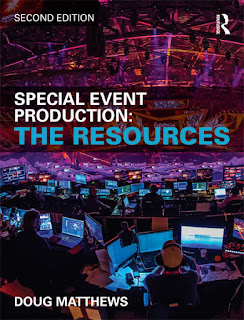
I have finally completed the revisions to my two popular textbooks, Special Event Production: The Process and Special Event Production: The Resources and they are with the publisher.

Lots of new material in these, including brand new chapters on Event Design, Information Technology, and Sustainability, plus updates of every chapter in both books. Updates concentrate on bringing emerging technologies into the knowledge base, things like the digitization of pretty well everything that is part of a special event, from audio, lighting, and video, to the use of technology as entertainment and as decor.

As well, besides the war stories and production challenges that have been extremely popular in the original versions, there is a new feature called "The Voice of the Industry" in every chapter. The voices are exactly that - opinions and comments from some of the biggest names in event production from around the globe. Part of the purpose for these was to be more inclusive of all the countries that are now producing amazing events and for whom there is not a lot of international exposure. Experts hail from China, India, South Africa, Russia, Egypt, Germany, Brazil, and of course Canada, the USA, the UK, and Australia.

There has been a wholesale changeout of images so that the books now incorporate some spectacular event images from every corner of the world.

Look for the new books to be available in the fall of 2015. I will keep you posted as to availability and cost.

Monday, 30 June 2014

Web Sites - What ARE Some of You Thinking?

The reason there have not been many posts on my blog over recent months is that I am heavily engrossed in writing revisions to my two textbooks on special event production, due for publication in the fall of 2015.

In doing the research for the books, I have had to scour the web for information, mostly photographs, as well as interview numerous experts in the industry. I thought it might be useful to share with you some of my discoveries in terms of the quality of the product out there and how it affects my thinking.

Let's start by assuming that the reason most event companies have a web site is to attract business. From what I have found, some companies do it extremely well, and others fall drastically short. The ones who do it well have the following in common:

1. The site loads extremely quickly, within four or five seconds. If it does not, I leave.

2. There is no silly or overly fancy or overly artsy front page telling me to wait, or worse, not telling me anything useful. This is one of my biggest pet peeves. If there is, I leave.

3. The front page of the site is attractive and highly visual. However, there is no cutesy music or repeating video playing. If there is, I leave.

4. Navigation to the information I want - invariably event images or company background - is simple, effective, and very fast. If I get taken in circles to other pages I don't want, or those pages I do want take more than a couple of seconds to load, I leave.

5. The images of events that the company has done are of the highest quality. This is absolutely critical to me in forming a good opinion of the company. They must load almost immediately and should be of high enough resolution to fill at least half my screen. I don't really care if there is a watermark on them as long as I can see the quality of the work without squinting. If you as a company are worried about your ideas being stolen, you are sadly misguided. It is far more important to have readily accessible a large number of high quality images. It will do you far more good than worrying about the very remote possibility that your ideas may be stolen. On that note, if you are that worried, then you better take another job since you probably don't have enough ideas to start with. If the images are not large enough or of high enough quality in terms of what appears to be the company's work at an event, I leave. Word to the wise - hire the best photographer that money can buy to take photos of your event.

6. They may use videos but they are short (i.e. less than 2 minutes) and get right to the heart of the matter, whether it is showcasing entertainment or reviewing an actual event.

7. The company information is complete and honest, telling me how the company came into existence, who the main owners are, and exactly what the company specialties are. No beating around the bush, no verbosity - straight to the point.

8. They do not use a form to fill out as the only method of contact. I have encountered so many companies that do not list any email addresses or even contact phone numbers. What on earth are they even doing on the web if they do not want anyone to get in touch with them?? This is perhaps the most idiotic concept that any company could use. List all your key employees, what their jobs are, and their direct phone numbers and email addresses. Not only have I sent countless such forms to companies asking for information, but most NEVER answer. You can be sure I will never seek out those companies again.

There you have it, a bit of a load off my chest. If it makes you re-think your web site strategy and design, then I hope I have helped you. Web design has come a long way in the last few years and it is not difficult to create a site with the qualities I have discussed.

Thursday, 24 April 2014

The Event Safety Guide - GET A COPY!!

This week I received in the mail a copy of The Event Safety Guide: A Guide to Health, Safety and Welfare at Live Entertainment Events in the United States.

It is unfortunate that they included the words "United States" in the title because this guide could be used in any country with appropriate changes to referenced standards and regulations. It is, bar none, the most comprehensive book on event risk management that I have ever seen.

The Event Safety Alliance (ESA) published the book. The alliance was born after several high-profile disasters (e.g. the Indiana State Fair stage collapse in 2011) threatened the reputation of the industry, causing concerned industry professionals to get together. The result was not only the formation of the ESA, but also this ground-breaking publication.


With everything you need to know all in one place, the guide contains 39 chapters (and 354 pages) on all areas of event risk, from medical and first aid to food, rigging, special effects, and on and on. These are not just simple checklists or references to other publications, but detailed explanations of what to watch out for in each specific area. It is the accumulation of years of experience from event professionals.

Since standards and guidelines such as this are only voluntary, there is not yet any mandatory requirement for event producers and managers to follow it. However, as an industry, it would be my strong suggestion that lobbying begin to turn it into a regulation.

You can purchase the guide for $49.95 USD in hard copy or electronic format from the ESA web site at http://eventsafetyalliance.org.

Well done ESA!!

Saturday, 16 November 2013

Trusted Event Planning Tips For Your Business

Melanie Woodward, founder and event planner, created Event Planning Blueprint as a result of her own experience starting events with little experience. Since 2004, when she started her event planning business, she has planned events around the world, worked with celebrities and sports professionals, planned multi-million dollar events, and has helped event planners with no experience start planning their own events.

Melanie now creates event planning videos and approached me some weeks ago to be interviewed. The results of that taped interview can be seen in the video below.

Melanie covers a wide variety of topics in special event planning. Check her out at http://www.eventplanningblueprint.com.